
Posted On: October 28 2026
Mental health services take place in a variety of spaces - hospitals, community centres, offices, public health buildings, schools, and the list can go on and on. Often times, these spaces can feel quite clinical - but, what does that mean?
A “clinical space” often has:
Neutral-colours; like, off-white walls or “institutional" blue” for pops of colour; lots of whites and light greys
Bright, often with fluorescent overhead lighting
An abundance of specialized machinery and/or computers, and/or office supplies
Constant, low-level hums from monitors, lights, beeping, footsteps on marble-type floors that are echoed or heightened through the acoustics of the space
Smells of antiseptic cleaners and rubbing alcohol
Office-type furniture, board rooms / tables
Not a lot of space; very, very squishy, especially, if you are tall, fat, have a mobility aid, have a service dog
Uniformity - it can look like someone copied and pasted throughout the space
What this can look like in therapy settings is bland colours, empty spaces, a lot of office furniture (which, let’s be honest, is rarely ever comfortable), and an overall felt sense that is similar to going to your doctor’s office. I want to be clear, some people find comfort in this, and that is okay; I also want to acknowledge that this can create distance with our clients who are accessing the space - How can you expect someone to open up and be vulnerable if they are not feeling comfortable in the space?
At the beginning of my career, I asked myself - What would I want to see in a waiting room? What would be a cue for me that I trust this space or the person providing the service to me? What would I find cool or interesting? What would increase a sense of comfort, safety, and autonomy in the space?
Some things that came forward for me through this exploration:
Snacks
How many times have you had the busiest day of your life and forgot to eat something? How difficult is it to slow down and reflect on what is going on internally when you are hungry? We are living in such a fast-paced society, so many of us forget to take the time to tend to our bodies. Having snacks available for folks in the waiting room or as part of the check in of therapy is a tangible way that you can care for a person. Having options for healthier-types of foods, and, more comfort-based foods can be helpful too; this gives clients the autonomy to nurture their bodies in the way that they see fit.
Beverages
It seems very obvious but it is actually very overlooked in many clinical settings. Therapeutically, water does wonders to help people regulate and reflect. It also just makes sense to make water available and accessible for folks accessing the space; we all get thirsty. Additionally, tea is a wonderful way to tangibly provide warmth and care for clients; think about the last time you drank a warm tea with someone on a cold day. Coffee, juice and pop can also be helpful, especially for those needing a blood-sugar boost, or, for our sensory-seeking clients. It is also just a kind act to be able to offer something to someone; a low-stakes but meaningful gift from you to them. A moment of, “I’m thinking of you”, and, “I care.”
Fidgets
The way someone who needs fidgets will LIGHT UP when you have an accessible bowl/pile/container of fidgets available for them will always brighten my day. I, too, am someone who lights up when fidgets are readily available. Many see fidgets as “toys”, I see them as tools - for everyone, but especially within the Neurodivergent community. If I don’t have fidgets available, I am likely picking or biting my nails/skin, and/or pulling at my fingers. Many people will talk about how they “just like them”, they like having something to do with their hands, and that they help them release pent-up activation or energy. Fidgets are a great way to tangibly explore, understand and discuss regulation.
Art
Not just any art - art that reflects the people that I work with, art that reflects me, art that reflects the world around me, art made by local artists, art that amplifies love and purpose. For this particular space shown below, I started collecting and showcasing art from a number of sources:
I asked my colleagues if they wanted to showcase art that they had made
I asked my colleagues to ask their friends and family members who made art if they wanted to showcase their art in our waiting room
I asked my artist friends if they would be interested in donating or loaning pieces for the wall
I purchased pieces from artists selling at local events
I purchased pieces from artists online with messages that acknowledged and condemned social injustices and stood up for human rights
Eventually, I had clients that wanted to add their art pieces to the wall too
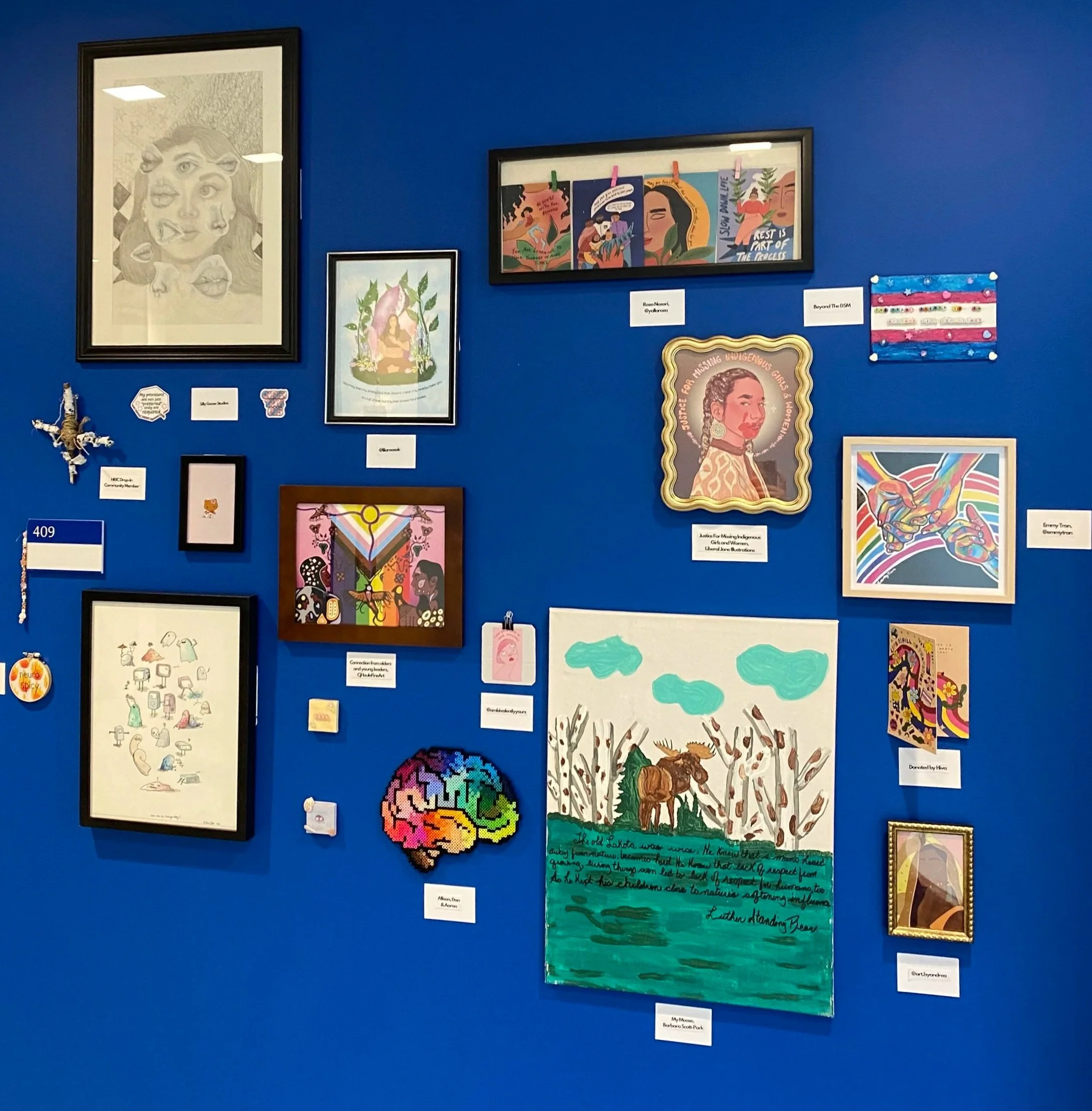
The Art Wall. The theme for the wall was Identity and Lived Experience. We left the theme broad to make space for creative freedom and diversity in perspectives, experiences, art-making, stories, interests and preferences.
Plants
Plants bring life into a space. They are also living beings, and will immediately communicate a lot about a space and the people in it. When the plants in a space are being watered, repotted, propagated and, overall, are cared for, you are cued that, at least one person (although, hopefully more) in the office, takes the time to tend to the space and the beings in it. They also bring life, oxygen and medicines into the space. The office depicted below, in particular, was located downtown, most downtown areas have been rid of nature, which makes finding and teaching regulation in nature difficult to do. Plants act as a mini version of regulation through nature; they act as reminders and physical cues for mindfulness and reflection; and they are lovely to look at and spend time with. Planting propagated plants is also a great activity to do with clients in session when they are interested in tangible and nature-based forms of grounding. They also make great gifts for anyone accessing the space - it feels good to share when there is an abundance of little baby plants.
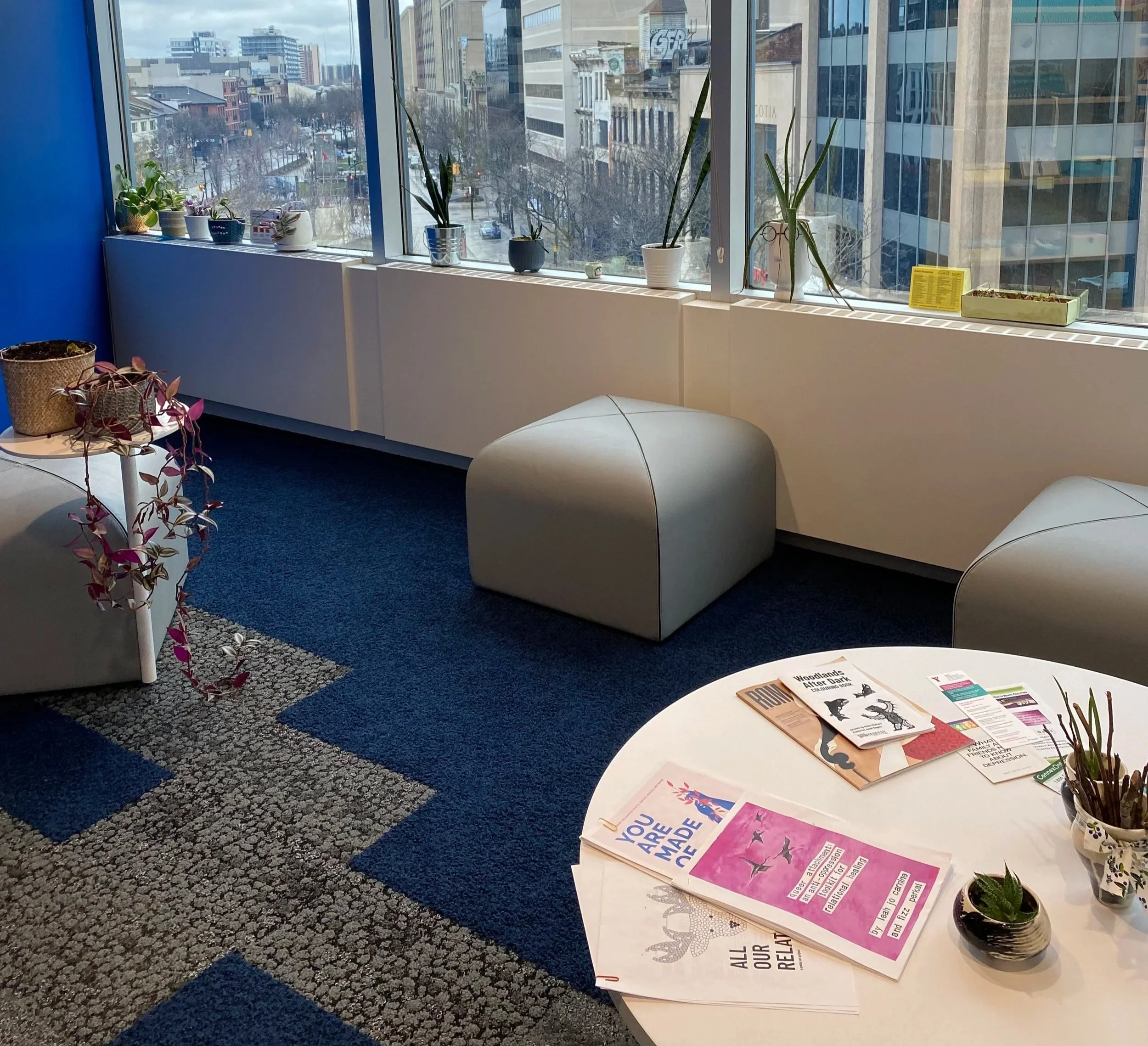
An important piece to note is that plants will fluctuate with the temperature and season. They rarely ever look uniform, but that is the beautiful thing about plants - they are unique individuals just like us.
You can also incorporate art into the planters that you use to hold the pots as well. Again, some people prefer everything to match; there is nothing wrong with that. This is one example of an endless amount of possibilities. In my own experience, for this space in particular, I did not have funding and was just making it work - a lot of the planters were my own, were donated or gifted. Personally, I like a diversity in planters, mugs, decor; it really depends on your intentions for the space, how you want people accessing the space to feel in the space, and what is available to you.
Interaction
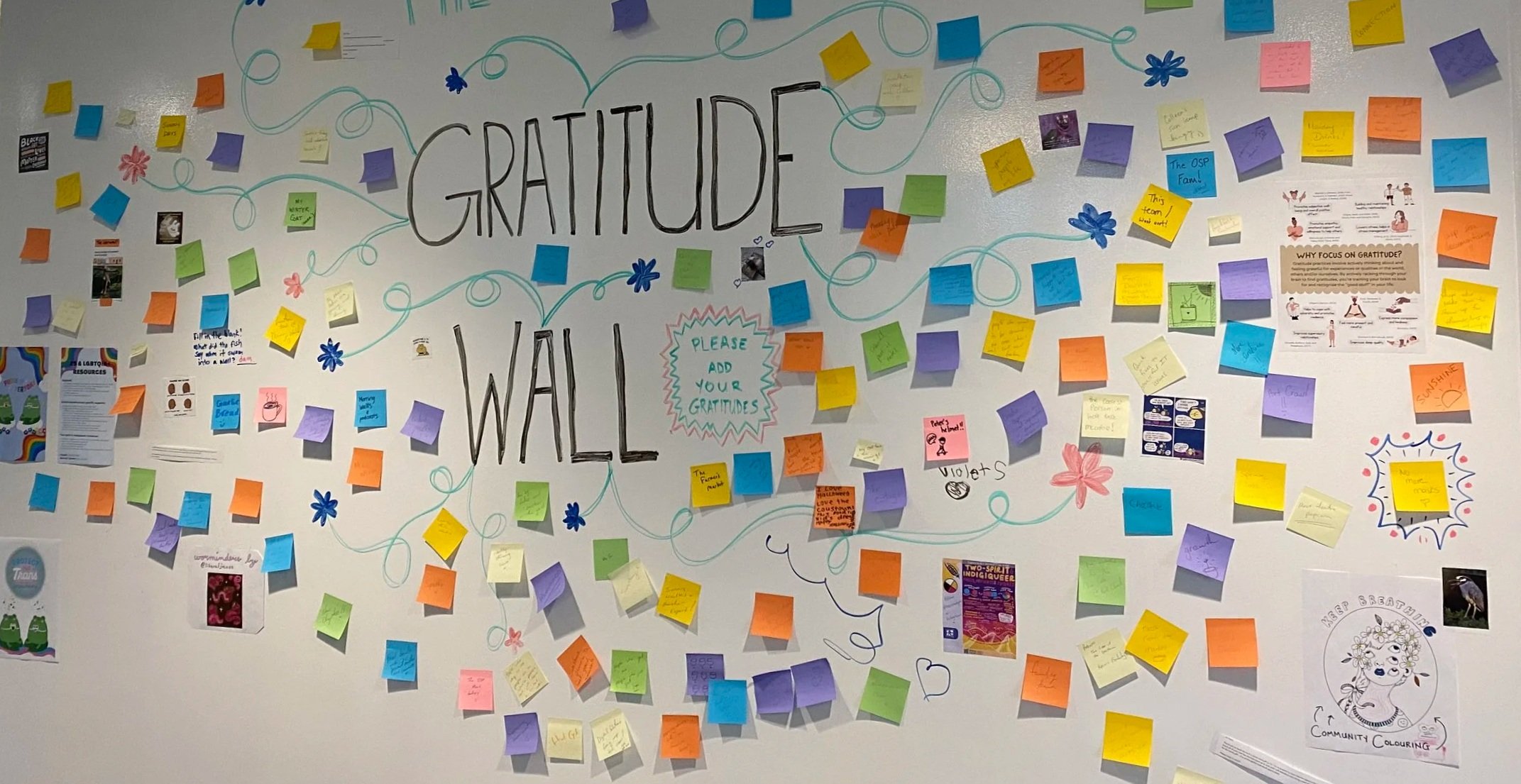
I’ve noticed over the years that one thing that will really stand out to me when I am accessing a space is my ability to interact with the space. I find that this helps me feel as though I am being invited to take up space and exist here; there is an encouragement of autonomy, reciprocity, common humanity, and feeling like I am actually wanted here. Interaction is one of my favourite things to play around with in my art and in the community programming that I run - How can we all come together to witness and hold space for, both, ourselves and each other? For the space depicted below, I had started a Gratitude Wall that people could add to, read from, and gather around. I found that this was great for the team working in the space - an invitation to take a moment to reflect on something that feels good or nourishing in some way, acknowledge it as something the person is grateful for, and share it with others. Many clients would comment on how reading the post-it notes gave them a moment of joy, nostalgia or laughter. Some clients incorporated adding to the wall as part of their “going to therapy routine”. It also felt like pops of colour, joy, fun and community on an, otherwise, very white wall.
I found it quite difficult to work in a clinically-designed office. I remember my own therapist informing me about the impacts that the aspects of a “clinical space” can have on us as a way to validate the experiences I was sharing with her. Many of the aspects of the space were either overstimulating or understimulating, and it felt like no one else had a problem with it. Be the change you want to see; therapists deserve cozy and kind spaces that feel good to be in to work out of. Our clients also deserve cozy and kind spaces to visit, unpack, process and take care of themselves.